
A product by Odingard Security
AI orchestration for physical operations.
ORCHESTRENT turns operational demand into coordinated execution across jobs, people, vehicles, deliveries, systems, and exceptions—while keeping consequential decisions inside explicit human and policy authority.
The operational control layer for physical logistics.
Why ORCHESTRENT
One Command Center. Total Visibility.
See jobs, deliveries, fleet activity, exceptions, approvals, and operational impact in one place.
Governed AI Decisioning. Always in Control.
AI prioritizes, recommends, and executes only within defined policy, authority, and workflow boundaries.
Connected Operations. End to End.
Coordinate ERP, procurement, fleet, telematics, scheduling, and communication systems through one operating layer.
Verifiable by Design. Every Action Proven.
External actions are checked against authoritative systems, with evidence and audit lineage attached to the result.
Pilot-Ready Architecture
Tenant isolation · Role-based access · Policy guardrails · Verifiable workflows
The Problem
Physical operations still run through disconnected decisions.
- Jobs, vehicles, drivers, suppliers, delivery windows, ERP systems, phone calls, and spreadsheets rarely share one decision layer.
- The problem is not a lack of software — it is coordination between systems and people when conditions change.
- Every disconnected decision becomes an exception someone has to chase by hand.
How It Works
The ORCHESTRENT loop.
Operational demand becomes coordinated execution—then the system observes, decides, approves, acts, verifies, and learns.
- Demand
- Plan
- Assign
- Dispatch
- Monitor
- Adapt
- Verify
Observe
Jobs, fleet, suppliers, delivery windows, system signals
Decide
Policy + AI prioritization over the live operation
Approve
Consequential decisions held for human authority
Act
Workflows, governed skills, assignments, dispatches
Verify
Proof of delivery, read-backs, state evidence
Learn
Lineage, audit, operational outcomes
Every automated action is bounded by policy and verified by evidence.
Command Center
One command center for the whole operation.
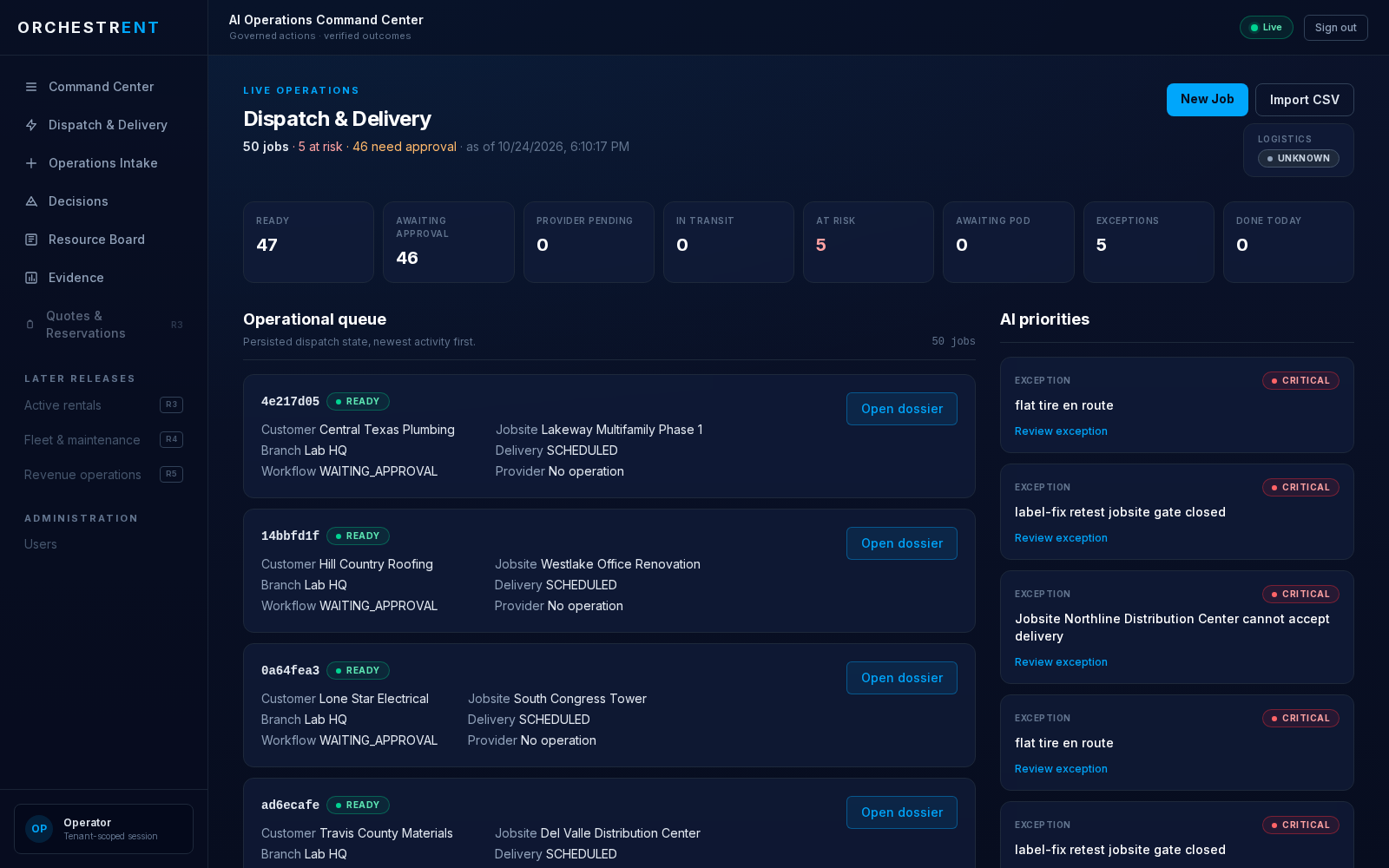
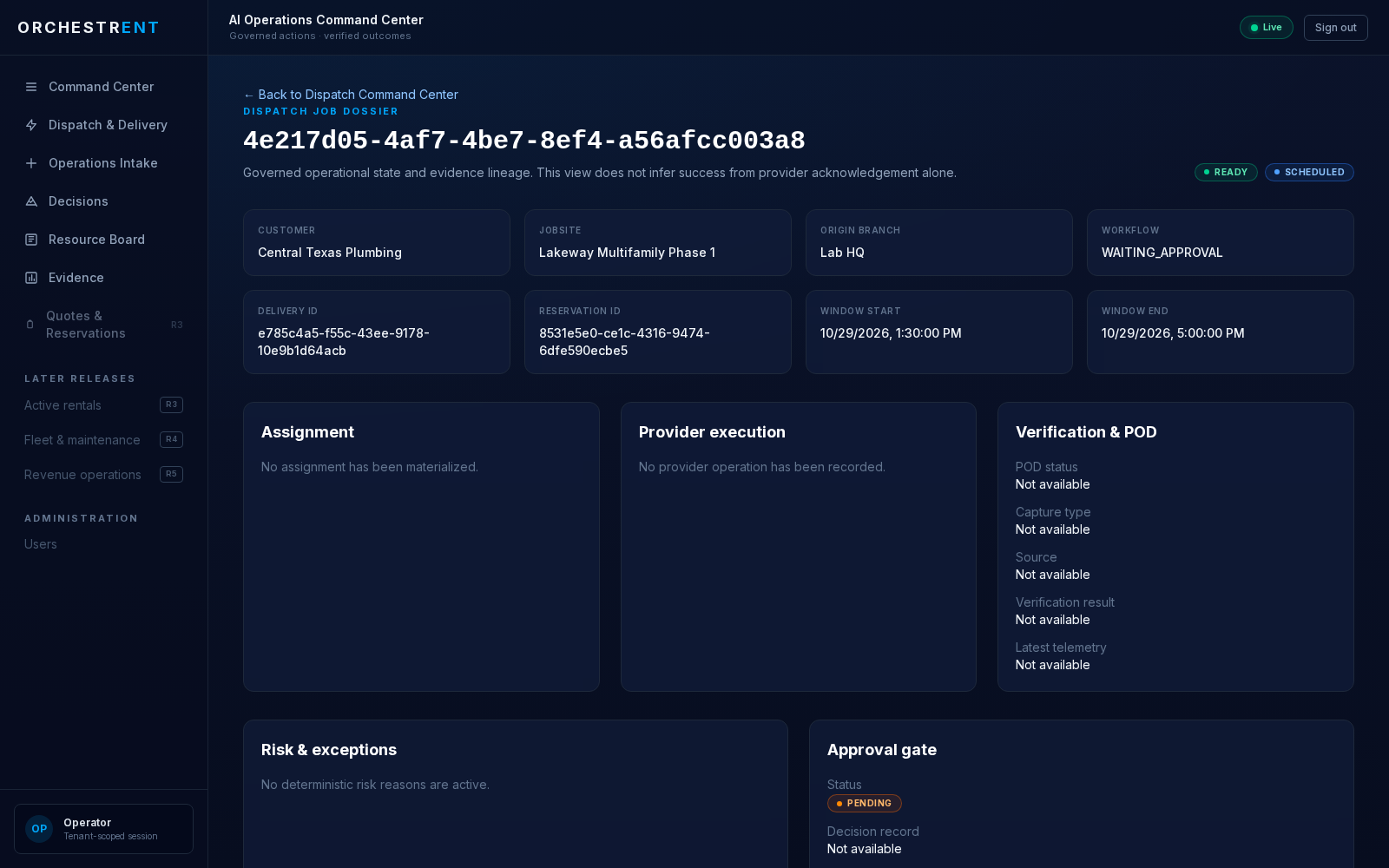
The operational queue, AI priorities, jobs awaiting approval, at-risk work, exceptions, resource state, and workflow status—visible in one place.
Operational queue
Ready, dispatched, in transit, and completed work.
AI priorities
What needs attention now.
Jobs awaiting approval
Consequential decisions held for a human.
At-risk work
Jobs flagged before they fail — unavailable resources, broken windows, job-site issues.
Exceptions
Delivery delay, provider failure, missing POD, operational conflict.
Workflow status
Where every governed job stands, step by step.
Operational AI
AI that reasons about the operation, not just the message.
ORCHESTRENT applies AI inside governed operating workflows—evaluating the live state of jobs, resources, and exceptions rather than answering isolated prompts.
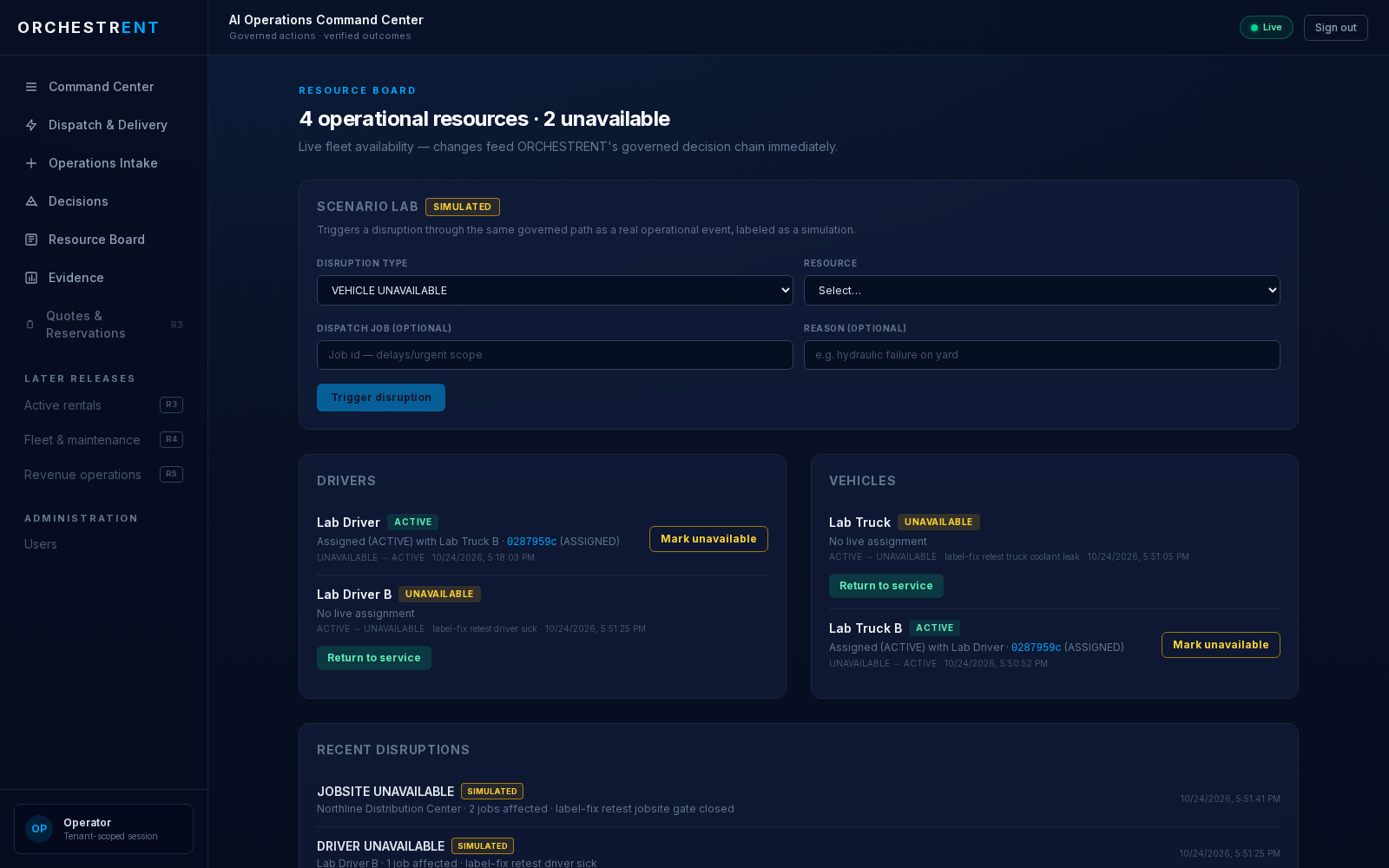
In the Operator Lab today
A truck becomes unavailable mid-day.
1
ORCHESTRENT identifies the affected jobs
2
Removes the unavailable resource from viable candidates
3
Evaluates alternative drivers and vehicles
4
Recommends a reassignment and explains why
5
Holds the consequential action for human approval
6
Continues the governed workflow once approved
Human Authority
Autonomy without surrendering control.
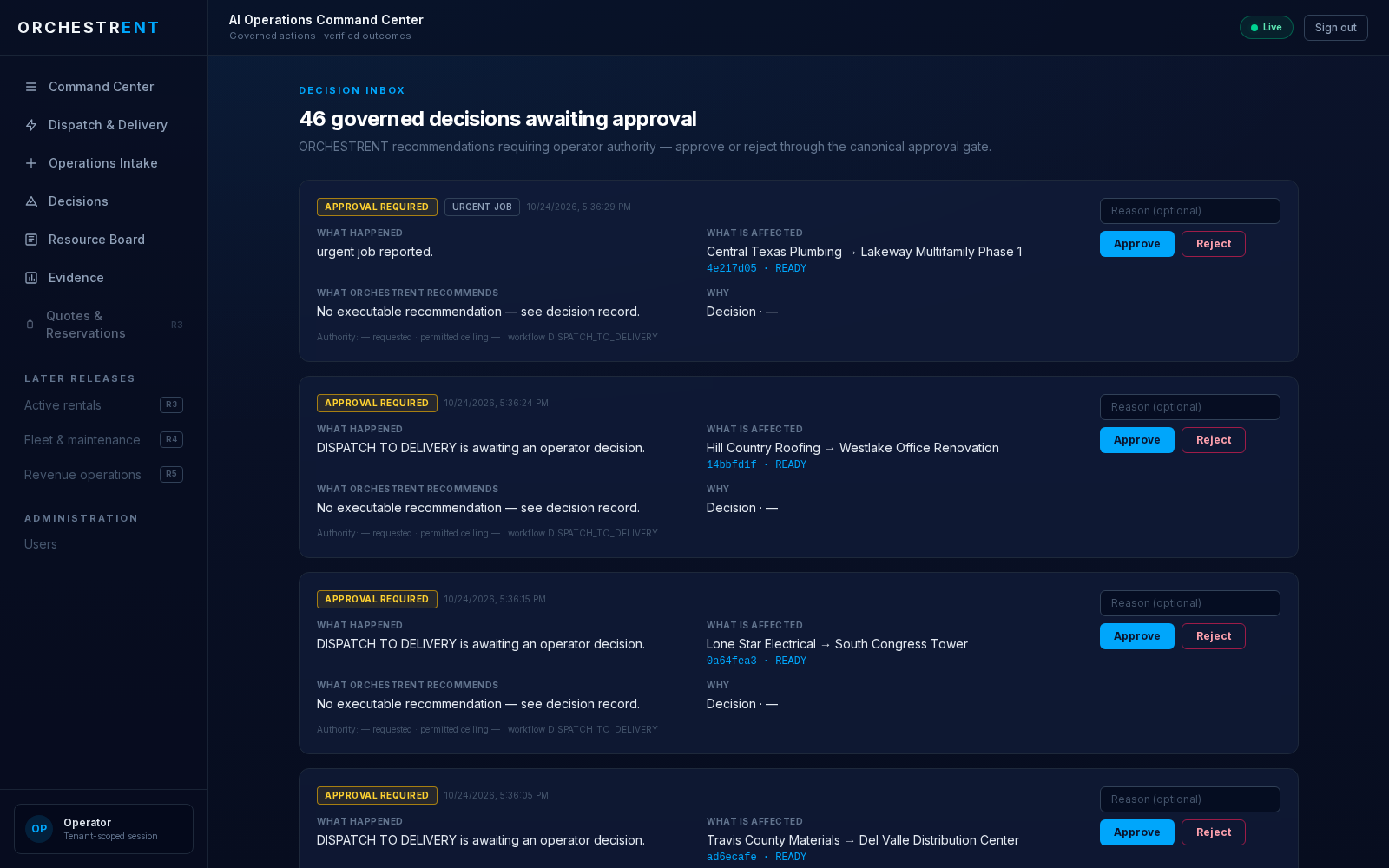
ORCHESTRENT separates deciding from acting. Authority is explicit, workflows are durable, actions are governed, and external outcomes are independently verified.
- Decision
- Authority Gate
- Workflow
- Governed Skill
- External Action
- Independent Verification
- Audit Record
L0
Observe
ORCHESTRENT watches operational signals and reports.
L1
Recommend
Actions are proposed; people decide and execute.
L2
Prepare + Approve
Work is prepared and held for explicit approval.
L3
Execute Within Policy
Bounded actions run automatically inside policy.
L4
Optimize Within Policy
Ongoing optimisation inside the same boundaries.
Human approval where required. Autonomous execution where permitted. Verification after action.
Today, pilot deployments run at observe–recommend–approve levels. Higher autonomy levels are earned per policy, not assumed.
Governed and verifiable by design
- Tenant isolation
- Role-based authority
- Approval gates
- Decision records
- Workflow lineage
- Idempotent external actions
- State history
- Independent verification
The System of Action
Your systems record the operation. ORCHESTRENT coordinates it.
Keep the systems your business already depends on. ORCHESTRENT turns fragmented operational signals into governed decisions, coordinated workflows, verified actions, and measurable operational outcomes.
Connected systems in
- ERP
- Procurement & material systems
- Fleet
- Telematics
- Communication
- Scheduling
- Delivery
- Customer systems
ORCHESTRENT orchestration layer
AI Decisions
Interprets operational signals, detects risk, and recommends the next action.
Workflows
Coordinates people, systems, and processes with durable execution.
Governed Actions
Policy-bounded, auditable, and aligned to explicit authority.
Governed operations out
AI Priorities
What needs attention now, in operational order.
Dispatch Execution
The right asset, to the right place, at the right time.
Exceptions
Issues surfaced early and routed for resolution.
Approvals
Human authority applied where policy requires it.
Verification
Actions confirmed against authoritative systems.
Operational Evidence
Decisions, approvals, and lineage kept for audit.
Connected systems in. Governed operations out.
Built Around Existing Systems
ORCHESTRENT coordinates the systems you already use.
Designed to orchestrate across existing operational systems—coordinating them instead of forcing a rip-and-replace transformation.
- ERP
- Procurement & material systems
- Fleet systems
- Telematics
- Communication
- Scheduling
- Delivery systems
- Customer systems
- Identity
Integration categories describe the systems ORCHESTRENT is designed to coordinate. Specific vendor integrations are confirmed per pilot.
Where We Start
Built for construction and industrial logistics.
ORCHESTRENT is initially built for operations where customer demand has to become coordinated physical execution.
- Construction materials
- Equipment movement
- Industrial supply
- Field delivery operations
- Specialty distribution
- Contractor-owned fleets
Shadow Pilot
Run ORCHESTRENT beside your existing operation.
Prove the value before you change anything. We are engaging construction suppliers, equipment operations, industrial distributors, contractor fleets, and delivery operations.
Request a Shadow Pilot- The customer does not have to replace its current dispatch process.
- ORCHESTRENT receives the same operational work, evaluates conditions, and produces recommendations.
- The dispatcher remains in control of every consequential decision.
- We compare what occurred with what ORCHESTRENT identified and recommended.
- Construction suppliers
- Equipment operations
- Industrial distributors
- Contractor fleets
- Delivery operations
See what your operation looks like when the decisions connect.
We are engaging a small number of physical-operations teams for shadow pilots — running ORCHESTRENT beside the operation you already run.